Changing Faces, Changing Lives
How and when to talk to your child about Craniosynostosis
Contents
Introduction
The information and advice provided below may not be suitable for every family. Preferences and needs vary, and there’s no single ‘right’ approach — it depends on what feels right for you. We encourage families to consider their unique circumstances and speak with healthcare professionals as needed.
Most children diagnosed with craniosynostosis undergo surgery in infancy, or while they are a toddler. Knowing when and how to tell your child about their diagnosis will depend on each child and family. Every child is different. Choose the words that fit your child’s age and temperament, and keep conversations short, honest and reassuring. Big feelings are normal: Children can feel worried,
shy or even wish they were “the same” as everyone else. Naming these feelings and reassuring them helps the conversation feel safe.
Your child may need multiple surgeries as they grow and develop. Letting them know this in a calm and caring way — when the time is right — can help reduce their anxiety and support their emotional wellbeing.
When to talk with your child about their Craniosynostosis diagnosis?
Telling your child about their craniosynostosis diagnosis can be a sensitive and important conversation.
The timing and approach can vary depending on their age, understanding, and emotional readiness.
Generally, it’s recommended to discuss it in a simple and age-appropriate manner when they are old enough to understand, usually around preschool or junior primary school age.
The details of your child’s craniosynostosis journey will probably be discussed many times over the years. You will likely describe what happened to them using different descriptions as they get older and depending on the specific questions they ask.
Your child’s story may be a lifelong conversation!
Explaining Craniosynostosis to a toddler or pre-schooler
Toddlers (Ages 1–3 years)
“Your head is growing in a different way and the doctors can help change how your head grows. We will talk to some doctors, who help lots of kids like you. Mummy and Daddy will be with you.”
Pre-schoolers (Ages 3–5 years)
“Your head has little seams, kind of like puzzle pieces. Some parts are growing together too early but that’s okay — the doctor is going to help fix this, so your head has room to grow big and strong!”
“Things are a little bit different for you and that’s okay, the doctors are really good at helping kids just like you.”
The Puzzle Piece Explanation
“Your skull is like a puzzle made of different pieces. These pieces are supposed to stay a little loose so your brain has room to grow. But for you, some of the pieces came together a little too early. Doctors can help fix that so your brain has plenty of space as you grow.”
The Room to Grow Explanation
“Your brain needs room to grow Inside your head…a bit like how your feet need space in your shoes. Your head bones grew a little too fast and didn’t leave enough space. So, the doctors will help give your brain more room to grow.”
The Garden Version (for kids who love nature)
“Your brain is like a little plant that needs space and sunshine to grow. The bones in your head closed up too early, kind of like a plant pot that’s too small. But your doctors are going to help make more space in your head so your brain keeps growing strong.”
Revised Warrior Story
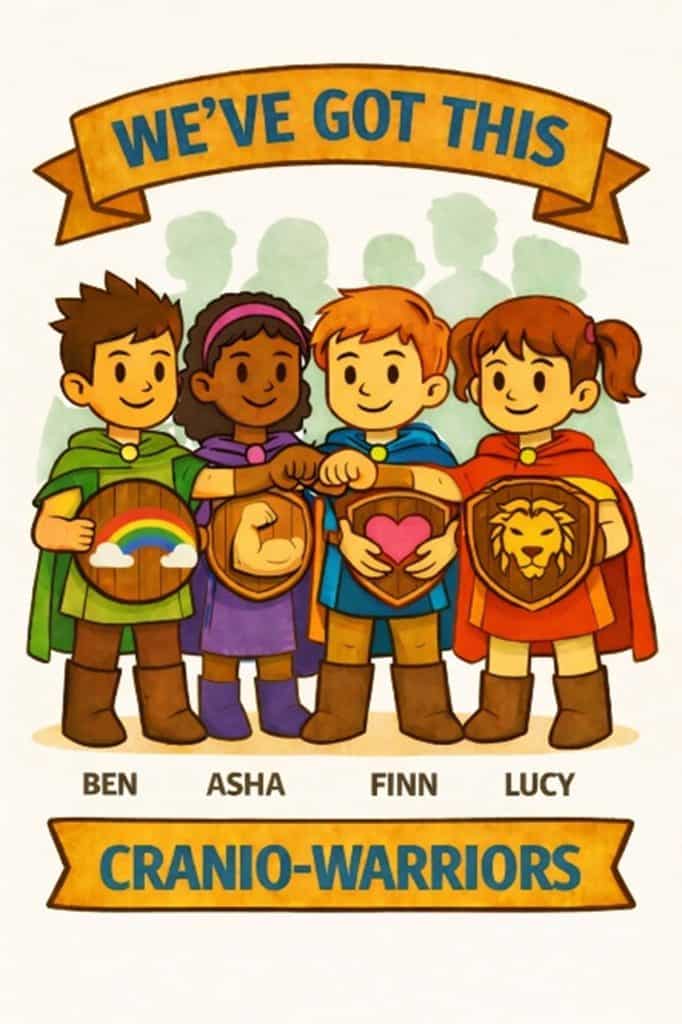
Under a bright banner that said “WE’VE GOT THIS,” four friends stood side-by-side:
Ben held a wooden shield with a small rainbow and clouds — he was the Warrior of Hope.
Asha carried a wooden shield with a strong arm on it — she was the Warrior of Strength.
Finn stood between Asha and Lucy, smiling, with hands holding a heart on his shield — the Warrior of Care.
And Lucy held a wooden shield with a lion on it — the Warrior of Courage.
They touched fists — bump! — a promise to help each other, always.
Finn once needed a little extra help when he was a baby.
“Some parts inside my head joined together earlier than expected,” Finn explained. Ben nodded. “Like puzzle pieces that clicked a bit too soon.”
“So the doctor-warriors helped,” Asha said gently. “They carefully created more space so Finn could grow comfortably.”
Finn smiled. “After my operation, my brain had the room it needed to grow strong.” Finn added, “And we take care of feelings too — because brave kids can have big feelings.”
Ben grinned. “Hope helps. Even a little rainbow can remind you that there are always bright spots!”
Asha lifted her shield. “And strength isn’t just muscles — it’s doing hard things, even when you feel worried.”
Lucy tapped the lion on her shield. “Courage is my lion. It reminds me I can be brave.”
Behind them, their support people stood close — quiet shadows in the background, always there.
Sometimes Finn visited the doctor-warriors for check-ups. “That’s how my team makes sure everything is going well as I grow,” Finn said. “And it wasn’t anyone’s fault.”
They fist-bumped again. Bump!
“Strength,” said Asha.
“Hope,” said Ben.
“Courage,” said Lucy.
“Care,” said Finn.
Together they called, “Cranio-Warriors!”
The banner fluttered above them: WE’VE GOT THIS — and they really did.

Explaining Craniosynostosis to an older child who had surgery in infancy
Children of primary school age can often understand slightly more complicated explanations, but make sure they still feel loved and supported. Give short facts, check what they heard and invite questions. Revisit the topic in small pieces rather than one long talk.
1. Start With Reassurance
Begin by making them feel safe and loved.
“There’s something different about you I want to tell you about—something about when you were a baby that helped you grow strong.”
2. Use Simple, Clear Language
Avoid medical jargon. Keep it visual and relatable.
“When you were born, the bones in your head were a little different. For most babies, when they are born, their skull bone is in 5 parts, so their head and brain can grow, but some of your skull bones were joined together. That’s called craniosynostosis.”
3. Introduce the Surgery
Make the surgery sound important, heroic and good for their development.
“Doctors noticed this early and wanted to help your head grow the way it needed to. So, when you were very little, you had a special surgery. It was like giving your head more space to grow and let your brain do all its amazing work.”
4. Explain the Outcome
Let them know they’ve had the surgery and they’re doing great.
“That surgery helped your head grow in a healthy way, and now you’re doing really well! You might have a scar, and that’s part of your story—it’s a sign of how strong you are.”
5. Answer Questions Openly
Let them ask anything and answer in a calm, non-scary way.
“Do you want to see pictures or ask me anything about it? I can tell you more whenever you’re curious.”
6. Empower Them
Finish with positivity and pride.
“You’re brave, and this is part of what makes you, you. Your head and brain are growing and developing, and you can do anything you dream of.”
Other things you could do and say:
- Use books or drawings to help them visualize.
- Reassure them that this is not something they did or could have prevented.
- You might say, “Your brain is super smart, and your surgery gave it the space it needed to grow!”
- If they’re nervous about being different, let them know:
“Everyone has something unique. Yours just happened to be surgery when you were tiny.”
Tips for managing your child's challenging feelings
When your child’s feelings run high, this section shows how to help—step by step. Try one or two ideas to start and build from there (as needed).
Worry or feeling embarrassed
- Say what you notice: “It sounds like you’re nervous about your scar.”
- Reassure: “Lots of kids feel like this. You haven’t done anything wrong.”
- Offer a simple re-frame: “Your scar shows your body healed after surgery.”
- Make a small plan: “If someone asks, you could say: ‘I had surgery when I was little—doing great now.’ Want to practise together?”
Wanting to be “the same”
- Validate: “It’s normal to wish you looked the same as friends.”
- Strengths check: List 3 things that make them them (kind, funny, great at soccer, loves art).
- Keep routine: School, sport, hobbies and time with friends help confidence grow.
Handling questions or stares
- One-line answer (then change topic):
“I had surgery to help my head grow when I was a baby.” - Agree on a signal: a hand squeeze or word they can use if they want you to step in.
- Boundary is okay: “I don’t feel like talking about that right now.”
Social media & body image
- Tidy the feed together: follow accounts that feel kind and real; unfollow ones that don’t.
- Notice the mood: if scrolling makes their feelings worse, have them take a planned break (music, short walk, quick game).
On appointment days
- Develop a coping plan: favourite playlist/podcast, slow breathing (in 4, out 4), fidget toys, a treat or short walk afterwards.
- Loop in school: let a key teacher know it might be a wobbly day.
When to get extra help
If their worry, sadness or avoidance lasts more than 2 weeks, or affects sleep, school or friends (or there are frequent headaches/tummy aches/nightmares), talk with your GP/paediatrician and consider a psychologist. You can also keep a simple question list for your next clinic visit.
Quick tools (pick one)
- Feelings scale (0–10): “Where is your worry now? Can we bring it down by 2?”
- Coping menu: choose 1–2 quick soothers (breathing • water break • short walk • music • draw).
- Traffic-light check-in: red/yellow/green before and after tough chats.
- Pause word: agree on a word or gesture to pause the conversation.
- Question list: add questions to your phone/fridge for next appointment.
Explaining regular check-ups
Children may wonder why they still need to see doctors after surgery. These simple explanations can help:
- Toddlers/Younger Children – “The doctors want to keep helping your head as it grows. Visiting them is how we make sure everything is going well.”
- Pre-schoolers/School-aged Children – “Your head is still growing, and the doctors need to check that everything is healthy. These visits help keep you strong.”
- Older Children – “Even though your surgery was when you were little, the doctors still need to check how your head and brain are growing as you get older. These appointments are to make sure you stay healthy.”
This information is based on the expertise of clinicians who work with families affected by craniofacial conditions and the lived experience of parents with children who have been diagnosed with craniosynostosis. We thank everyone who contributed to this fact sheet.